
For decades, the medical consensus was simple: parasites were a problem for developing countries, not places like Ireland, the UK, or the rest of Western Europe. If you hadn’t travelled somewhere “risky,” the assumption was you probably didn’t need to think about it.
New research is quietly rewriting that assumption.
Turns Out Parasites Aren’t Rare — They’re Just Rarely Looked For
A widely cited review of intestinal parasitic infections found roughly 20% prevalence in developed countries, compared to around 50% in developing countries — using standard diagnostic methods like stool microscopy (PMC, 2023).
But standard methods have a well-known weak spot: they miss a lot. Older testing relies on spotting parasites or their eggs directly under a microscope, which depends heavily on timing, sample quality, and the parasite actually shedding at the moment the sample is taken.
What the Science Actually Says
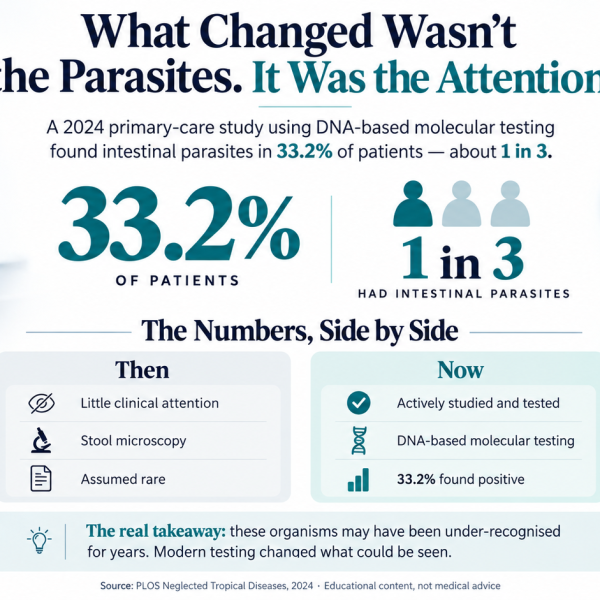
In 2024, researchers in France and Luxembourg took a different approach — testing primary care patients (people visiting their regular family doctor for everyday reasons, not people already suspected of having parasites) using modern molecular assays (DNA-based testing, far more sensitive than microscopy). This matters: it means the results reflect an ordinary, broad mix of people, not a group pre-selected because they already seemed likely to be affected. The result, published in PLOS Neglected Tropical Diseases:
- 33.2% of patients tested positive for at least one intestinal parasite
- 20.5% had Blastocystis sp.
- 13.1% had Dientamoeba fragilis
- 9.9% had more than one parasite at once
- 7.0% had a clearly pathogenic (disease-causing) species
That’s roughly one in three people — in a wealthy, industrialised part of Europe, using rigorous, real-world clinical testing. The researchers’ own conclusion was direct: “intestinal parasites are underestimated in industrialized countries.”
It’s worth noting what kind of parasites these actually were: the most common ones found, Blastocystis and Dientamoeba fragilis, are protozoa — single-celled, microscopic organisms — not the multicellular worms (like tapeworms or roundworms) that “parasite” often brings to mind. This matters, because it partly explains why they’re so easy to miss: something invisible to the naked eye, living quietly in the gut, doesn’t announce itself the way a visible worm might.
Being microscopic doesn’t mean small in impact, though. Unlike most worms, which typically don’t reproduce once inside a human host, these single-celled organisms multiply through simple cell division — meaning their numbers can genuinely grow over time inside one person, not stay fixed. Blastocystis alone is estimated to affect over 1 billion people worldwide, making it one of the most common gut colonisers on the planet. These organisms take up space and food your own gut bacteria need, and your immune system has to keep watching them — using energy in the background, even if you never feel sick. For some people, this may be part of why tiredness and low energy show up without an obvious cause.
This also fits a bigger, genuinely fascinating fact about the human body: we’re not as purely “human” as it feels. A landmark 2016 study recalculated the ratio of microbial cells to human cells in the body and found it’s roughly 1.3 to 1 — around 38 trillion microbial cells to 30 trillion human cells. Microscopic organisms are a constant, normal part of who we are; the question is which ones, and whether they’re helping or working against us.
Why the Old Numbers Were Wrong
This isn’t a case of parasites suddenly becoming more common. It’s that better tools are finally revealing what older tools were missing. Similar patterns have shown up elsewhere — reviews of strongyloidiasis, cryptosporidiosis, and giardiasis all describe the same story: real prevalence consistently higher than official figures once researchers look more carefully, using better technology, in Latvia, the Netherlands, Portugal, and beyond.
The picture emerging isn’t “parasites are everywhere and dangerous” — it’s something more measured and, honestly, more useful: many intestinal parasites are common, often mild, and frequently invisible to standard testing, which means a lot of people are walking around with one and have no idea.
The Symptoms — Obvious and Subtle
More obvious signs:
- Ongoing diarrhoea or loose stools
- Abdominal cramping or pain
- Noticeable bloating after meals
- Unexplained weight loss
- Nausea
Subtler, easier-to-miss signs:
- Persistent low energy or fatigue that doesn’t match your sleep or lifestyle
- Intermittent digestive discomfort that comes and goes without a clear pattern
- Mild, ongoing bloating that you’ve started to think of as “just how your stomach is”
- Changes in bowel habits that aren’t dramatic, just different from your normal
It’s worth being clear here: many people with an intestinal parasite have no symptoms at all, or symptoms mild enough to be dismissed as everyday digestive sensitivity. That’s precisely why the “underdiagnosed” finding matters — the absence of dramatic symptoms doesn’t mean the absence of a parasite.
What This Means for You
If you’ve had ongoing, unexplained digestive symptoms — bloating, irregular bowel habits, fatigue you can’t quite explain — and you’ve never specifically been tested for parasites, this research is a reasonable prompt to ask your doctor about it, particularly requesting modern testing methods if standard stool tests have come back clear before.
This isn’t about panic. It’s about recognising that a genuine gap exists between how common these organisms actually are and how often people think to check for them.
This article is for educational purposes and reflects published research as cited. It is not medical advice. If you have ongoing digestive symptoms, please consult your doctor or a qualified healthcare practitioner for proper testing and diagnosis.
Sources:
- Intestinal Parasitic Infections in 2023, PMC/NIH
- Current status of intestinal parasitosis and microsporidiosis in industrialized countries: Results from a prospective study in France and Luxembourg, PLOS Neglected Tropical Diseases, 2024

